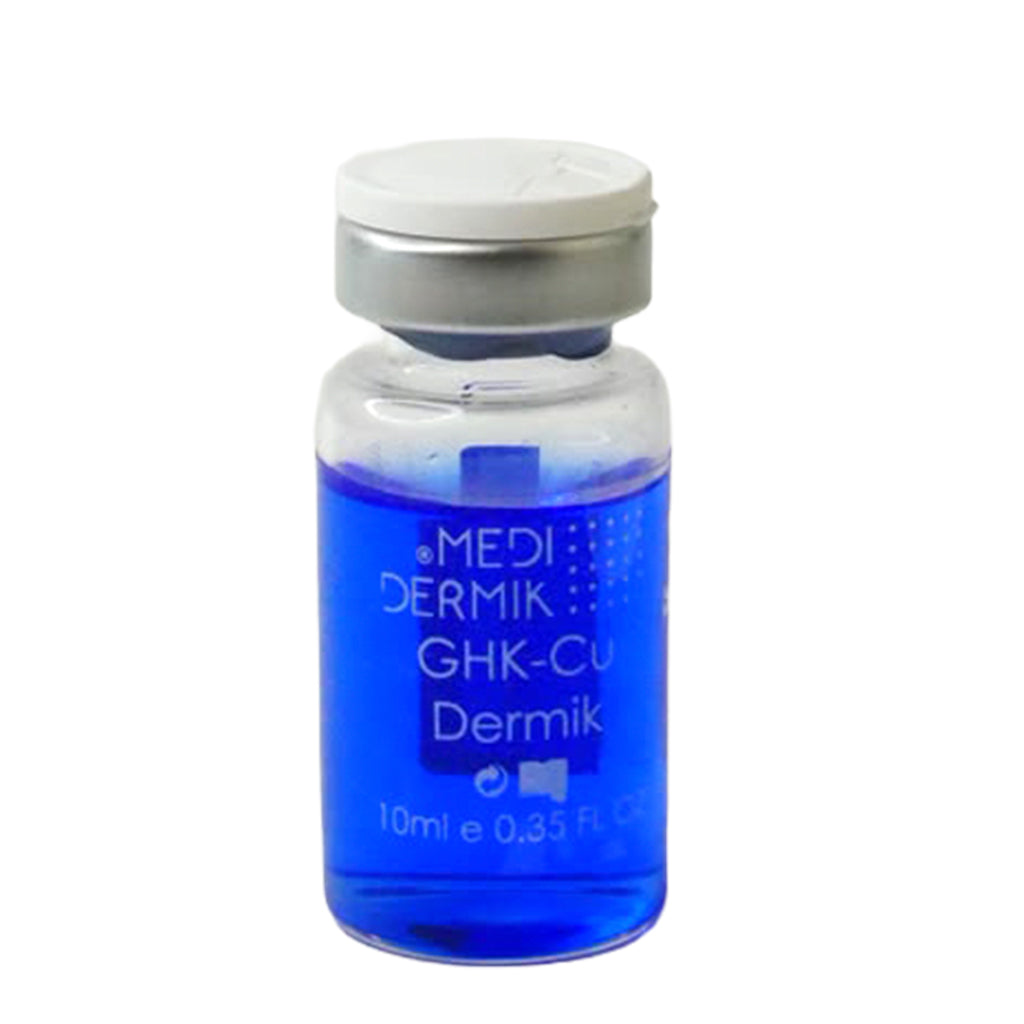
Nova Skin Medidermik
GHK-Cu Dermik (Copper Tripeptide-1) 100mg/vial
GHK-Cu Dermik (Copper Tripeptide-1) 100mg/vial
Couldn't load pickup availability
GHK-Cu Dermik 5 vials, each 100mg
GHK-Cu Dermik (Copper Tripeptide-1) is formulated to help improve the appearance of photo-aged skin, rosacea, scars, stretch marks, dilated pores, alopecia and flaccidity, including the look of wrinkles, collagen loss, inflammation, uneven tone, dullness, dryness, and loss of firmness. It is an excellent option for supporting skin’s natural regeneration, and anti aging effect.
Presentation
- 5 vials of 10ml each (50ml total) (100mg per vial)
Indications
- Appearance of fine lines and wrinkles
- Visible loss of collagen and firmness
- Rosacea
- Scars, stretch marks, and dilated pores
- Alopecia (Hair Loss)
How to Use
GHK-Cu Dermik (Copper Tripeptide-1) can be applied through:
- Virtual Mesotherapy with Electroporation
- Iontophoresis (Galvanic Current)
- Microneedling with dermapen or dermarollers
- Post-peel topical application
- Post-microdermabrasion topical application
- Topical application with massage
Key Ingredient
- Copper Tripeptide-1 (100mg/vial)
Ingredient Properties & Benefits
GHK-Cu Dermik 5 vials x 10ml (Copper Tripeptide-1)
Peptides in general represent a paradigm shift in clinical skincare — moving beyond passive moisturization toward cell-communicating biochemistry. Unlike traditional actives (retinoids, AHAs), peptides deliver targeted signals to fibroblasts, keratinocytes, and melanocytes, stimulating collagen synthesis, accelerating tissue repair, and modulating muscle activity with minimal irritation. For licensed aestheticians, this translates to measurable, science-backed outcomes that justify premium service pricing and build long-term client retention.
GHK-Cu Dermik’s mechanism of action:
- Activates fibroblasts
- Upregulates Matrix Metalloproteinases (MMPs) enzymes for extracellular matrix (ECM) remodeling
- Promotes angiogenesis
Treatments Uses:
- Microneedling serums
- Post-laser recovery
- Wound-healing protocols
- Anti-aging facial infusions.
Matrix metalloproteinases (MMPs) are a family of zinc-dependent enzymes that break down proteins in the extracellular matrix (ECM), such as collagen, elastin, and gelatin. They are crucial for normal tissue remodeling, wound healing, and angiogenesis.
Copper Peptide-1 (GHK-Cu) stimulates fibroblasts through a combination of cell signaling, gene activation, copper delivery, anti-inflammatory effects, and extracellular matrix remodeling. Its mechanism is one of the reasons it has become so important in regenerative aesthetics and advanced skin rejuvenation.
The active complex is:
GHK{-}Cu
where:
GHK = Glycyl-L-Histidyl-L-Lysine (a naturally occurring tripeptide)
Cu = Copper ion (Cu²⁺)
What Happens at the Cellular Level:
1. Fibroblast Activation & Gene Signaling
GHK-Cu acts as a biological signaling peptide. When it binds to fibroblast receptors, it influences gene expression involved in:
- Tissue repair
- Collagen synthesis
- Elastin production
- Wound healing
- Anti-inflammatory responses
Studies show GHK-Cu can upregulate genes associated with:
- Collagen I
- Collagen III
- Elastin
- Glycosaminoglycans
- Proteoglycans
and downregulate:
- Inflammatory cytokines
- Tissue-damaging enzymes
Result: Fibroblasts shift into a more regenerative and youthful state.
2. Copper Delivery Mechanism
Copper is essential for many enzymes involved in skin repair.
GHK acts like a copper transport carrier, delivering bioavailable copper directly into cells.
Copper is necessary for enzymes such as:
Lysyl Oxidase
This enzyme cross-links collagen and elastin fibers.
Collagen\ Crosslinking → {Lysyl\ Oxidase} Stronger\ Extracellular\ Matrix
Result:
- Stronger dermal structure
- Increased firmness
- Better elasticity
- Improved wound repair
3. Stimulation of Collagen Synthesis
Fibroblasts exposed to GHK-Cu increase synthesis of:
- Type I collagen
- Type III collagen
- Decorin
- Dermatan sulfate
Why this matters:
Aging fibroblasts gradually lose collagen-producing capacity.
GHK-Cu partially reverses this decline by activating regenerative pathways.
Clinical effects
- Reduced fine lines
- Improved skin thickness
- Better elasticity
- Smoother texture
4. Anti-Inflammatory & Oxidative Stress Reduction
Chronic inflammation accelerates fibroblast aging.
GHK-Cu helps reduce:
- Reactive oxygen species (ROS)
- Inflammatory cytokines
- Oxidative damage
Mechanisms include:
- Superoxide dismutase (SOD) support
- Free radical scavenging
- Reduced NF-κB inflammatory signaling
Result:
Fibroblasts function more efficiently and survive longer.
5. Extracellular Matrix Remodeling
GHK-Cu helps regulate:
Matrix metalloproteinases (MMPs)
Tissue inhibitors of metalloproteinases (TIMPs)
This creates healthier extracellular matrix turnover.
Why important
Aging skin often has:
- Fragmented collagen
- Disorganized elastin
- Accumulated damaged proteins
GHK-Cu promotes remodeling toward healthier matrix architecture.
6. Stem Cell & Regenerative Signaling
Emerging research suggests GHK-Cu may influence:
- Stem-cell activation
- Cellular differentiation
- Tissue regenerative pathways
This is why it is now heavily used alongside:
- Exosomes
- PDRN
- Microneedling
- RF microneedling
- Laser recovery protocols
Why Fibroblasts Respond So Strongly
Fibroblasts are the primary dermal cells responsible for producing:
- Component
- Function
- Collagen
- Structural support
- Elastin
- Elastic recoil
- Hyaluronic acid
- Hydration
- ECM proteins
- Tissue architecture
GHK-Cu essentially signals fibroblasts to return to a “repair mode” similar to younger skin.
Why GHK-Cu Is Important in Aesthetic Medicine
It combines multiple actions simultaneously:
- Collagen stimulation
- Anti-inflammatory activity
- Wound healing
- Antioxidant protection
- Matrix remodeling
- Regenerative signaling
That multi-target activity is why it is considered one of the most advanced peptide technologies in modern skin rejuvenation.
Simplified Mechanism Flow→
GHK{-}Cu → Fibroblast\ Activation→ Collagen\ Production + ECM\ Remodeling + Reduced\ Inflammation → Skin\ Rejuvenation
Clinically Observed Benefits:
- Skin Effects
- Firmer skin
- Reduced wrinkles
- Improved elasticity
- Better hydration
- Faster healing
- Reduced redness
- Post-Procedure Uses
Especially useful after:
- Microneedling
- Laser resurfacing
- Chemical peels
- RF microneedling
because fibroblast activity is critical during tissue repair.
Why Interest Is Exploding Now
GHK-Cu fits perfectly into the current movement toward:
- Regenerative aesthetics
- Skin longevity
- Low-inflammation rejuvenation
- Barrier preservation
- Biotech-driven skincare
Instead of damaging skin aggressively, modern protocols increasingly focus on stimulating the skin’s own repair biology.
NovaSkin & MediDermik
Professional formulations designed to support modern skincare protocols.
Disclaimer:
This compound has not been evaluated by the FDA. It is not intended to diagnose, treat, cure, or prevent any disease. All use must follow institutional and regulatory guidelines.